
Consumers Eye Sustainable Apparel From Brands
November 13, 2025

The fashion world is shifting fast, and organizations like the Textile Exchange and the Sustainable Apparel Coalition have done a lot to push that shift forward. The momentum is there. What the industry still struggles with is helping people understand what sustainability actually looks like in practice—and how to make sense of the terms used to describe it.
Consumers Are Trying to Choose Sustainable Apparel, but the Language Gets in the Way
Right now, today’s clothing customer is incredibly confused. They might see a shirt made out of bamboo fibers and think to themselves, That sounds sustainable. In reality, that bamboo is rayon. And rayon has been around for a long time and has historically been made with some very toxic chemicals. But with a little clever branding, no one would ever have to know.
This is the core issue: shoppers genuinely want to buy responsibly, but the vocabulary used across the apparel industry doesn’t help them make informed decisions. Words like “natural,” “green,” and “eco-friendly” show up on tags and marketing materials without any real explanation of how the fiber was processed, what chemicals were used, or how the finish performs over time. Without context, it’s incredibly difficult to tell the difference between sustainable textile finishes and easily marketable claims.
Why “Natural” Sells and “Sustainable” Gets Overlooked
More and more consumers are drawn to labels that sound wholesome, even when there’s very little evidence supporting the claim. Modern sustainability expectations are much stricter than they were a decade ago. Buyers want transparency, third-party validation, and clear proof that a product reduces impact—not just language that feels environmentally friendly.
Just look at the chart below. It shows consumers are 10% more likely to purchase something labeled natural than something labeled sustainable, even though sustainability requires a far higher level of responsibility, testing, and documentation.
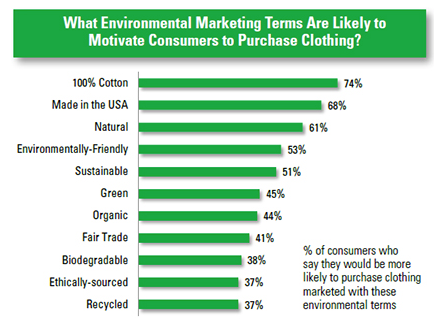
That gap between what sounds good and what actually matters has created years of confusion for shoppers and brands alike.
The Reality No One Wants to Advertise
No company wants to tell customers the plain truth about how much environmental impact each purchase has. Could you imagine a brand putting out ads that say, Don’t buy a jacket from us unless you really need it. That’s how you can truly create a sustainable future. That would be marketing suicide.
But the idea behind it is honest: fewer garments produced and discarded equals less environmental harm. It’s simple math.
Now imagine a company saying, Buy a jacket from us, and you’ll never need to buy another one. That’s a sustainable message people can actually support.
Durability is one of the places where sustainability and performance align perfectly. Products that last longer reduce waste, reduce replacement cycles, and reduce the resources required to manufacture something new. Most people don’t think about the environmental impact of a garment’s lifespan, but it’s one of the most practical ways to cut overall footprint.
Textile treatments play a central role in this. When a finish stays effective through repeated washing and wear, the garment stays useful for far longer. Modern sustainability frameworks now treat longevity as a measurable part of environmental performance.
Sciessent’s Role in Creating More Sustainable Apparel
As a supplier of antimicrobial, anti-odor, and water repellent technologies to many leading brands, we at Sciessent want to contribute to more responsible product development. Our focus has always been on performance technologies that last—because longevity supports both the customer experience and the sustainability story behind the garment.
As part of our effort to expand our sustainable product offerings, our bluesign®-approved Lava XL odor absorber recently achieved the OEKO-TEX® Eco Passport certification. Sciessent is the first U.S. company to pass this rigorous test.
Eco Passport is valuable because it examines chemical safety at the ingredient level, not just on the finished product. Textile finishes that pass are verified to be free from dangerous levels of substances like allergens, carcinogens, and other harmful residues. For brands, this level of validation helps support compliance, responsible manufacturing, and consumer transparency.
How Lava XL Supports More Sustainable Textile Design
When you combine the Eco Passport certification with the long-lasting, proven odor-control performance of Lava XL, you get one of the most responsible textile finishes a brand can include. Lava XL maintains its effectiveness through repeated washing and sustained wear, which extends the useful life of the garment.
A finish that performs longer helps prevent premature disposal and reduces the need for frequent replacements. It keeps products in circulation longer and supports a more thoughtful approach to apparel production.
For brands prioritizing sustainability, durability, and verified chemical safety, technologies like Lava XL contribute measurable value. It’s an approach that aligns with where the industry is headed—and with what today’s informed customers expect.